Introduction
- Artificial intelligence (AI) is ushering in a new era in medicine. Recent advances, particularly in generative AI, have expanded its role across administrative and clinical workflows alike. As health care continues to confront rising costs, workforce strain, and persistent physician burnout, AI is increasingly viewed as a practical tool to help support a more sustainable care model.1,2
- As the leading digital platform for U.S. medical professionals, with more than 3 million members, including over 85% of physicians, Doximity is uniquely positioned to elevate physician perspectives and assess AI adoption at scale. Drawing on survey responses from 3,151 U.S. physicians across 15 specialties and two study periods — March–April 2025 and November 2025–January 2026 — this report examines who is adopting AI, how it is being used, what benefits physicians are experiencing, and where barriers remain.
- Adoption and interest are widespread: 94% of physicians surveyed said they are currently using AI or are interested in doing so. Physicians are applying AI to a wide range of use cases to help reduce administrative burden, streamline documentation, and support communication. Many report meaningful gains in efficiency, job satisfaction, and patient care, alongside clear opportunities to reduce after‑hours work and expand time for patients.
- At the same time, physicians are clear that AI's promise must be matched with rigor. Concerns about accuracy and reliability remain, and nearly half confirm that institutional AI policies are still evolving. Report findings reflect a profession that is both pragmatic and optimistic: encouraged by AI's early impact and realistic about its limitations.
- Consistent with Doximity's philosophy of building with doctors, for doctors, this report aims to elevate physician perspectives to help guide how AI is developed and integrated into care.
- With thoughtful development and strong clinical leadership, AI has the potential not only to improve efficiency, but to strengthen the foundation of medicine, restoring time, focus, and humanity to patient care.
- 94% of physicians surveyed are currently using AI or are interested in doing so.
AI Landscape: Optimism and Barriers
AI Optimism
Physicians Recognize AI's Potential to Improve Workload, Patient Care
The promise of AI in medicine is generating meaningful enthusiasm among physicians.
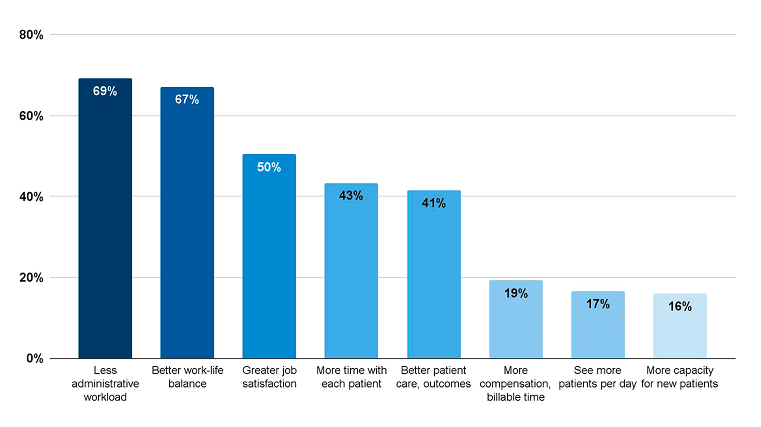
When asked what excites them most about AI's potential in their practice, physicians cited reduced administrative workload (69%) most often, followed by the opportunity for improved work‑life balance (67%) and greater job satisfaction (50%).
Many also see AI as a path to better care: 43% of all physicians surveyed reported they are excited about spending more time with each patient, and 41% about improving patient care and outcomes.
These findings suggest that physicians view AI not simply as a tool to improve productivity, but as a way to restore time, focus, and fulfillment in the practice of medicine.
What Excites You Most About the Potential of AI in Your Practice?*
*Physician respondents selected all that applied.
Barriers to Adoption
Physicians Report AI Policies and Guidelines Are Still Evolving
Yet, as AI becomes more integrated into clinical practice, health care institutions are grappling with the best way to set policies and guidelines for its use.3 Nearly half of all physicians surveyed (47%) reported the AI decision‑making process at their institution is "still evolving." Only 8% reported that the process is clear, and they understand the policies and guidelines.
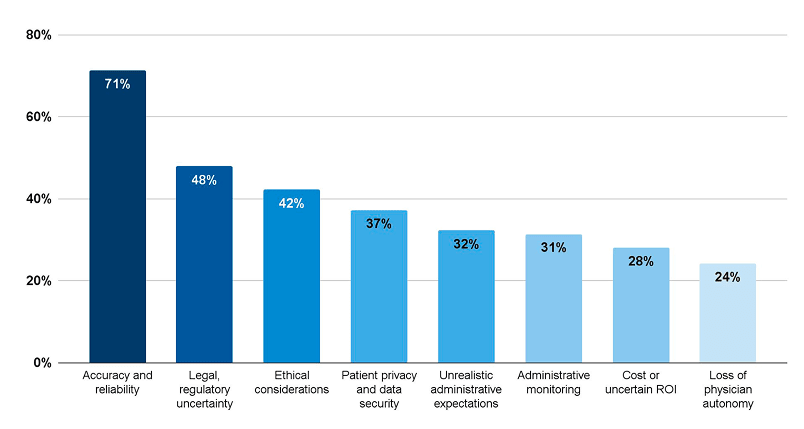
Physicians also identified several barriers or concerns that could potentially slow AI adoption. The most‑cited concern among physicians surveyed was the accuracy and reliability of AI‑generated outputs (71% of surveyed physicians).
Notably, accuracy and reliability was the top‑cited AI concern among all physician age groups and all 15 specialties studied. It was cited by 78% of pediatricians, the highest rate among all specialties.
What Are Your Greatest Barriers or Concerns When It Comes to Using AI in Your Practice?*
*Physician respondents selected all that applied.
Current AI Adoption, Use Cases, and Benefits
Current AI Adoption and Interest
Overall, 94% of Physicians Are Either Using AI or Interested
Current AI adoption appears to be strong and growing. Across all 3,151 U.S. physicians surveyed, 94% reported they are either using AI in their clinical practice or interested in doing so. More than half (54%) reported currently using AI in their clinical practice, and only 5% said they are not interested in using AI.
AI adoption appeared to rise markedly over the past year, from 47% of physicians surveyed in March–April 2025 to 63% of those surveyed in November 2025–January 2026.
Men physicians reported slightly higher adoption than women (57% vs. 49%), though interest was nearly identical, with only 5% of both groups indicating no interest in AI.
Are You Currently Using AI in Your Practice?*
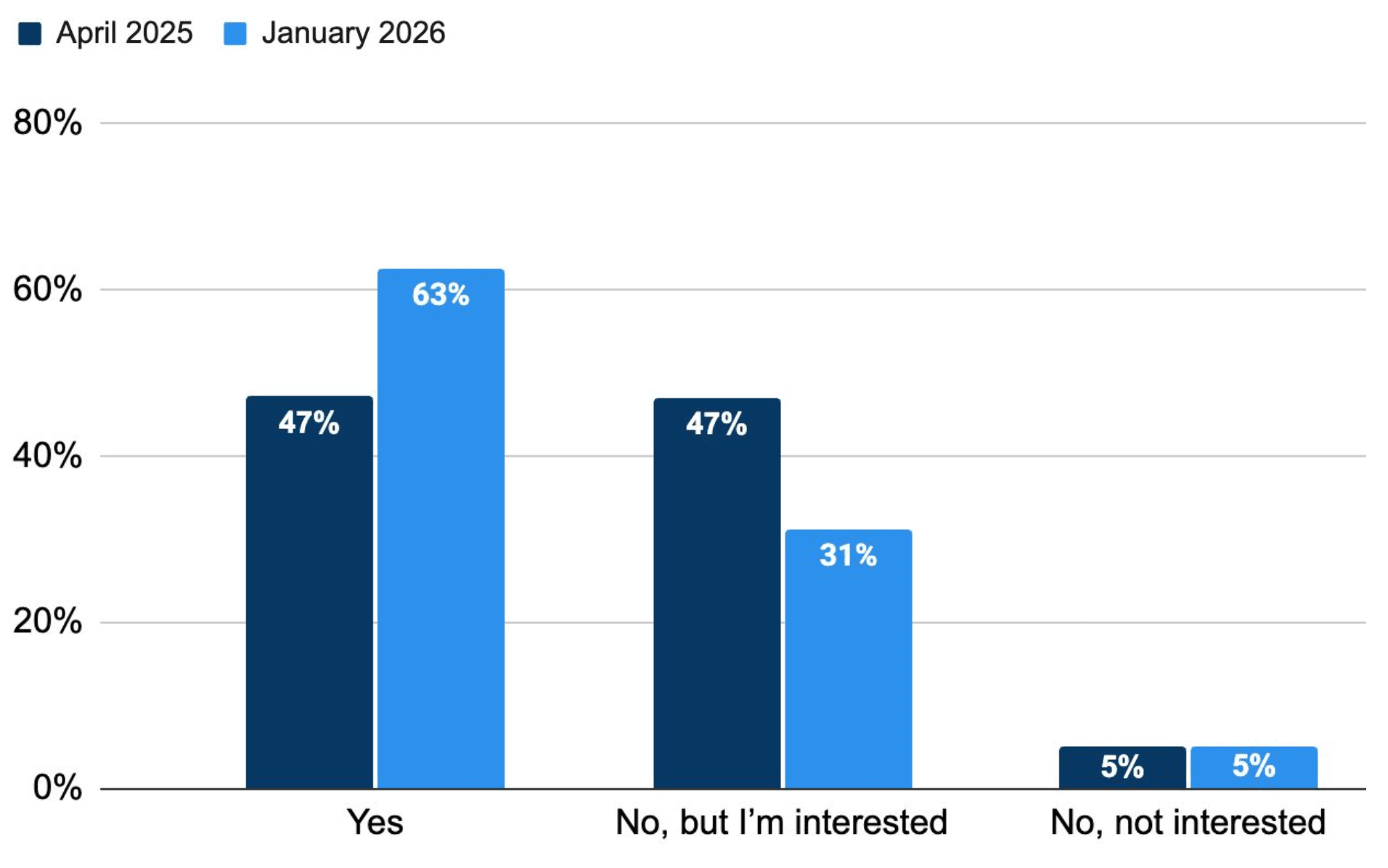
*Date ranges are from March–April 2025 and November 2025–January 2026.
Adoption by Physician Age
AI Use Spans All Physician Age Groups
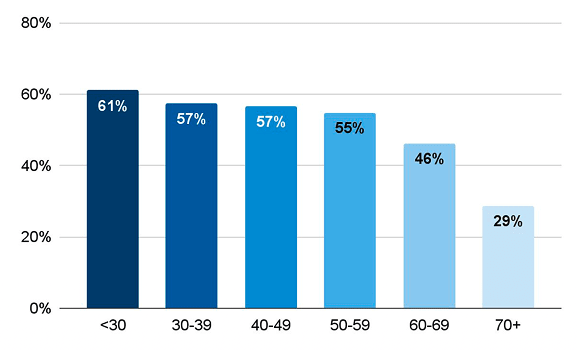
Physicians across all age groups are using AI in their clinical practice. More than 61% of physicians 30 and under said they are currently using AI in their practice, compared with 57% in their 30s and 40s and 55% in their 50s. While current adoption was lower among those 60 and older, just 11% of physicians in that age group reported no interest in AI.
Physician AI Adoption by Age
Adoption by Physician Specialty
Cross-Specialty Adoption Signals Growing Role for AI in Medicine
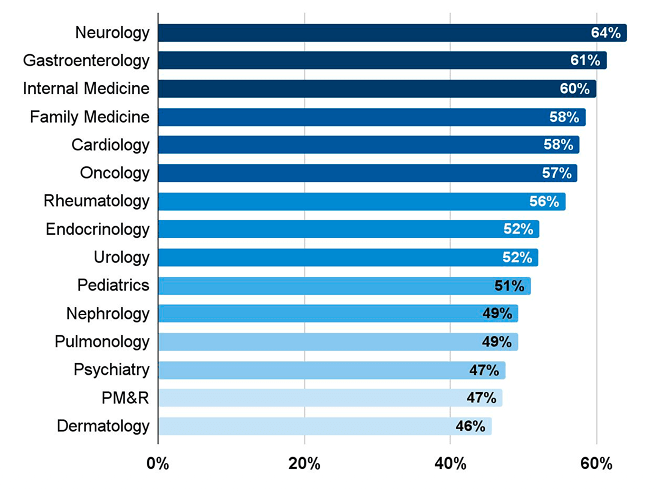
Though still in its early stages, AI adoption is already widespread across medical specialties. Among the 15 specialties studied, neurology reported the highest rate of current AI use (64% of neurologists surveyed), followed closely by gastroenterology (61%) and internal medicine (60%). Family medicine and cardiology each reported 58% adoption, with oncology close behind at 57%.
Adoption rates remained above 50% across several additional specialties, including rheumatology, endocrinology, urology, and pediatrics.
Overall, the data indicate that AI adoption is distributed broadly across both primary care and specialty practices, underscoring its versatility in diverse clinical settings.
Physician AI Adoption by Specialty
Adoption by Use Case
Physicians Applying AI Across Clinical, Administrative Workflows
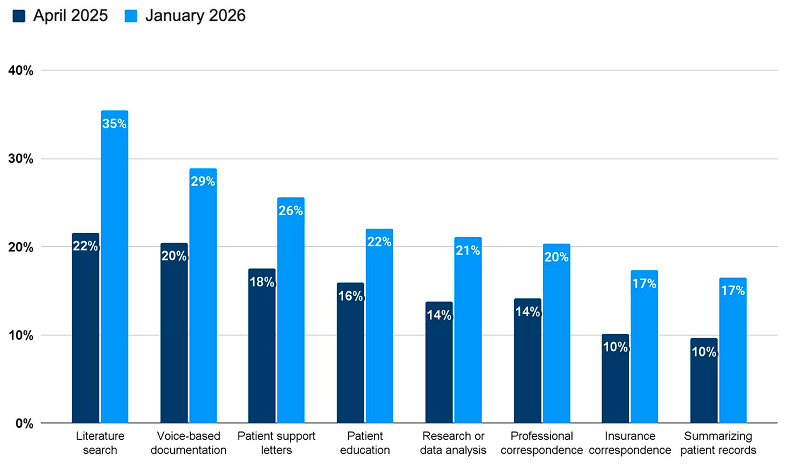
Physicians are adopting AI to streamline a wide range of administrative and clinical workflow tasks, with usage increasing across nearly every major category over time.
The most common use case reported was literature search (35% of physicians surveyed in January 2026, up from 22% in April 2025), followed by voice‑based documentation tools such as ambient listening or AI scribes (29%, up from 20%).
Beyond these leading applications, physicians are increasingly using AI for writing, research, and administrative tasks, including drafting patient support letters and educational materials. Growth has also been notable in administrative burden–related areas, with more physicians turning to AI for insurance correspondence, such as prior authorizations, and for summarizing lengthy patient records.
These findings show that AI is not confined to a single function but is being integrated more deeply across the full spectrum of clinical and operational workflows.
How Physicians Are Using AI in Their Practice*†
*Physician respondents selected all that applied.
†Survey dates are March–April 2025 and November 2025–January 2026.
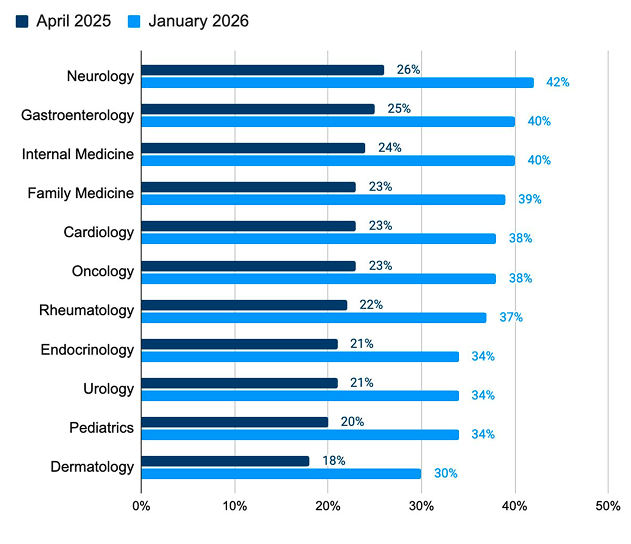
Literature Search by Specialty
Estimated % of all physicians in each specialty using AI for literature search | 2025 vs. 2026*
*Survey dates are March–April 2025 and November 2025–January 2026.
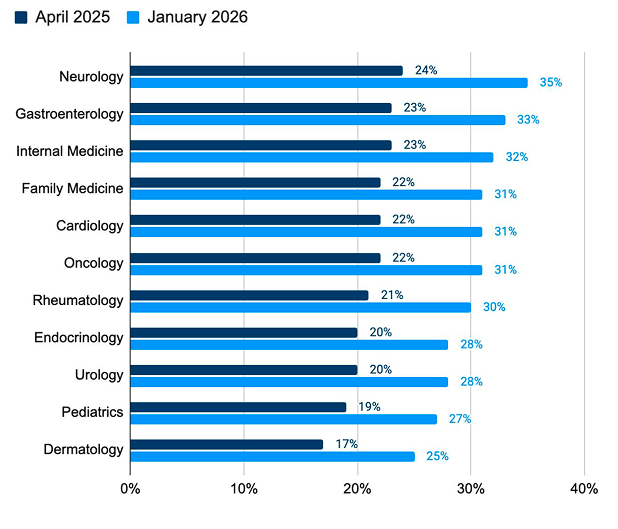
Ambient Note-Taking by Specialty
Estimated % of all physicians in each specialty using ambient AI documentation | 2025 vs. 2026*
*Survey dates are March–April 2025 and November 2025–January 2026.
Frequency of Use
Once Adopted, AI Is Used Daily By Majority of Physicians
Once physicians adopt AI, it appears to secure a recurring role in their clinical practice. More than one‑third (37%) of all physicians surveyed reported using AI in some capacity at least daily.
Among AI users specifically, 69% reported daily use, including 36% who use AI multiple times per day.
Usage frequency also appears to be increasing over time. In March–April 2025, 64% of physician AI users reported using the technology at least daily, rising to 74% in the November 2025–January 2026 survey.
Notably, family medicine physicians emerged as some of the most frequent AI users. Among those who have adopted the technology, 88% reported daily use, including half (50%) who use it multiple times per day.
How Often Do You Use AI in Your Practice?*†
Percentages Specific to Physician AI Users (Non‑Users Excluded)
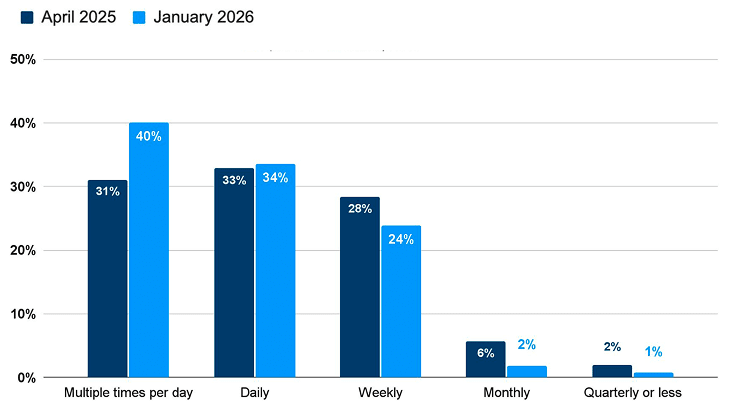
*Due to rounding, numbers may not sum to 100%.
†Survey dates are March–April 2025 and November 2025–January 2026.
Early Impact and Benefits
Three-Quarters of Physician AI Users Report Reduced Administrative Burden
Physicians using AI in their practice reported clear benefits over the past year, especially around reducing administrative burden, improving job satisfaction, and enhancing work‑life balance.
Three‑quarters (75%) of physician AI users surveyed reported the technology has already reduced administrative burden and improved job satisfaction. Notably, 69% of physician AI users reported better patient care and outcomes as a result of applying AI to their work.
While fewer physicians identified immediate benefits in areas like increased billable time, compensation, or patient volume, the number who did observe such benefits is still notable, particularly at this early stage of AI adoption. For example, nearly half (49%) of physician AI users reported having greater capacity to take on new patients as a result of using AI.
Over time, as physicians become more experienced and confident using AI, these benefits may become more apparent.
How AI Has Impacted Physicians' Work in the Past Year*
Percentages Specific to Physician AI Users (Non‑Users Excluded)
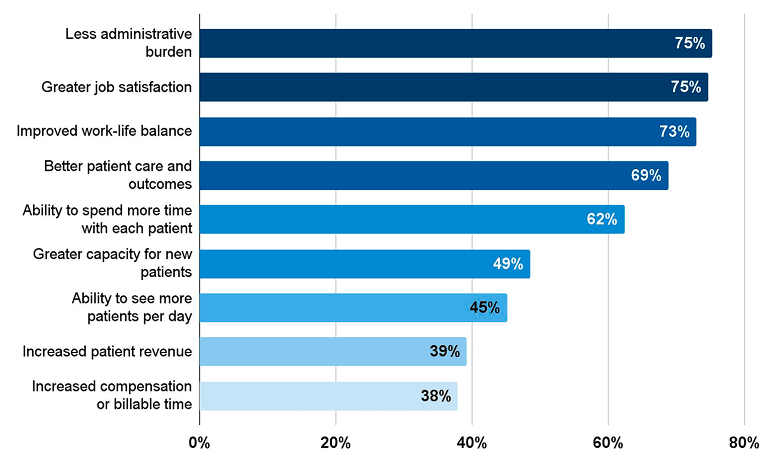
*Physician respondents selected all that applied.
Future AI Use and Impact
How Physicians Want to Use AI
Physicians Express Strong Demand for AI Across Workflows
Physicians across the board reported high interest in applying AI to a variety of tasks. Among all physicians surveyed, including both current AI users and those who have not yet adopted the technology, the majority expressed interest in AI for many common use cases.
The strongest interest was in literature search (87% of all physicians surveyed), drafting patient support letters (86%), patient education (84%), and insurance correspondence tasks, such as prior authorizations (82%). More than 80% also expressed interest in using AI for document translation and summarizing patient records.
Interest remained substantial across several documentation, research, and communication tasks, including voice‑based documentation, such as ambient scribe technology (79%).
The majority of physicians also reported interest in applying AI to some of the more advanced or operational applications, such as interpreting medical images or test results (58%).
Overall, these findings suggest broad curiosity and openness to AI across core clinical workflows.
How Physicians Want to Use AI in Their Clinical Practice*
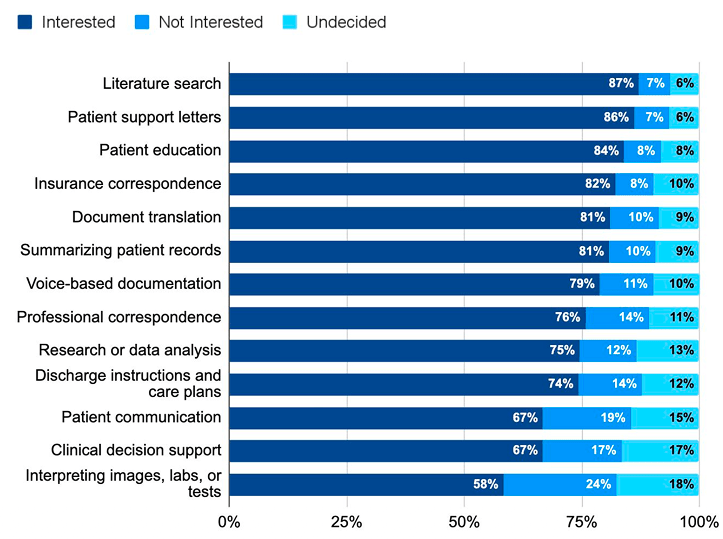
*Due to rounding, numbers may not sum to 100%.
Impact on Burnout, Workload
Physicians Say AI Can Lower Burnout, Increase Time for Patient Care
Physicians see major potential for AI to relieve pressure in clinical practice. An overwhelming 88% of all physicians surveyed said AI can help reduce burnout and improve job satisfaction, a figure that rises to 92% among current AI users, including 44% of AI users who reported AI has already made a difference.
Optimism runs even higher when it comes to increasing time for patient care: 91% of all physicians surveyed believe AI can help reduce administrative workload and free up more time for patient care. Among AI users specifically, 40% reported AI has already helped increase time for patient care by reducing administrative workload.
If administrative burdens ease, the payoff for patients could be significant. About two‑thirds (65%) of all physicians surveyed estimated that AI could help them reallocate one to five hours per week toward direct patient care, and another 21% said it could free up six or more hours.
Do you believe that AI can help reduce physician burnout and increase job satisfaction?
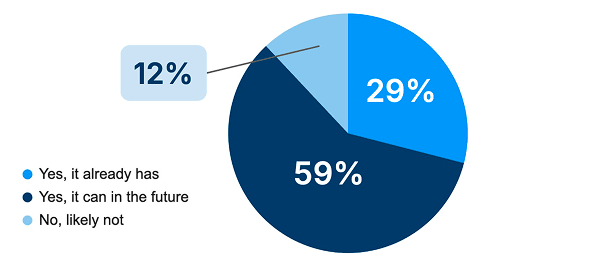
Do you believe that AI can help increase time for patient care by reducing administrative workload?*
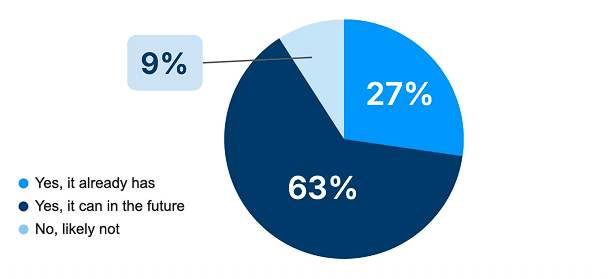
*Due to rounding, numbers may not sum to 100%.
Impact on After Hours Work
90% of Physicians Say AI Could Reduce Pajama Time, or Already Has
Research shows that for every hour of direct patient care, physicians spend nearly two additional hours on EHR and desk work during the clinical day, with another one to two hours on clerical work each night.4
According to the American Medical Association, off‑hours work, commonly referred to as "pajama time," forces physicians to sacrifice personal and family time, which can take a significant toll on their well‑being and overall job satisfaction.5
According to physicians, AI has the potential to help. The large majority (90%) of all physicians surveyed reported AI has either already reduced pajama time or could do so in the future. More than one‑third (36%) of current AI users said that AI has already reduced pajama time.
On average, physicians estimated that AI could cut their weekly pajama time by nearly half (a 48% reduction), with some indicating that AI could eliminate pajama time altogether.
Do you believe that AI can help reduce "pajama time"?*
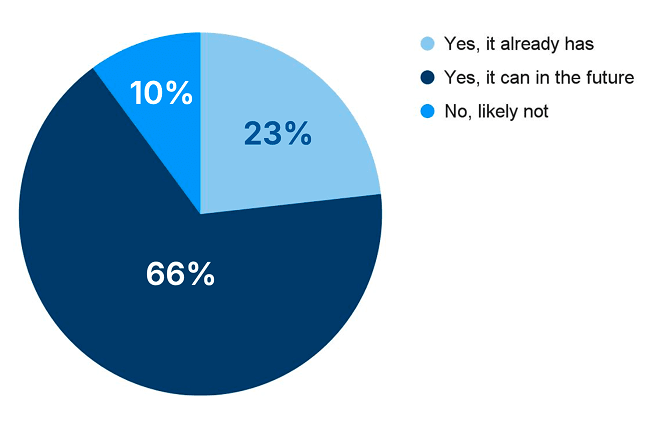
*Due to rounding, numbers may not sum to 100%.
Reinvesting Time Saved
Physicians Say Free Time, Personal Wellness Are Top Priorities
AI has the potential to free up meaningful time for physicians, time many would prefer to reinvest in their own personal lives or wellness.
If AI reduced their administrative workload and "pajama time," 75% of physicians said they would like to use the reclaimed hours for personal time, and 72% for their own wellness.
Given the strain that many physicians are under, these preferences for renewal and recovery are understandable. In a 2025 Doximity poll of nearly 2,000 physicians, 85% reported feeling overworked, and 68% said they are considering an employment change or early retirement.6
At the same time, many physicians would like to reinvest reclaimed time directly back into patient care. Nearly 37% of all physicians surveyed reported they would like to spend additional time with their current patients, and nearly one in five (19%) said they would like to take on new patients.
With a projected shortage of up to 86,000 physicians by 2036, even incremental time gains could meaningfully expand access to care for patients nationwide.7
If AI could meaningfully reduce your administrative workload and "pajama time," how would you prefer to use that reclaimed time?*
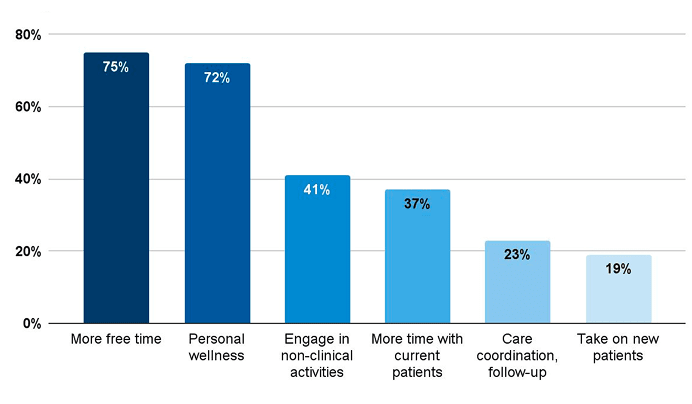
*Physician respondents selected all that applied.
Conclusion
- The emergence of AI is already reshaping health care.8,9 Its versatile applications across both administrative and clinical workflows are influencing not only how physicians practice medicine, but how they envision the future of their profession.
- Nearly 90% of physicians surveyed believe AI can help reduce burnout and improve job satisfaction, and more than 91% believe it can ease administrative burden and free up time for patient care. For many clinicians, the promise of AI is no longer theoretical. It is already delivering meaningful value in daily clinical practice.
- At the same time, unlocking AI's full potential will require continued validation, transparency, and thoughtful governance. Accuracy and reliability are essential. Building trust through evidence, physician verification, and responsible implementation will be critical to ensuring AI strengthens medicine in safe and sustainable ways.
- Rather than displacing the physician's role, AI holds promise as a partner. The future of AI in medicine is not about replacing humanity, but about reinforcing it, helping physicians spend more time where they are needed most: with their patients.
- The future of AI in medicine is not about replacing humanity, but about reinforcing it, helping physicians spend more time where they are needed most: with their patients.
Methodology
Methodology
Doximity conducted a survey of its physician members in March–April 2025 and then again in November 2025–January 2026. Participation did not require prior experience with AI or use of Doximity's AI tools.
A total of 3,151 U.S. physicians completed the survey, representing 15 specialties: cardiology, dermatology, endocrinology, family medicine, gastroenterology, internal medicine, nephrology, neurology, oncology, pediatrics, physical medicine and rehabilitation, psychiatry, pulmonology, rheumatology, and urology.
Among all 3,151 physicians surveyed, 54% reported use of AI in some capacity in their clinical practice. Survey demographics are not population‑based, and findings may not be generalizable to the broader physician population.
References
- 1Matheny, M; Israni ST; Ahmed M; et al. Artificial Intelligence in Health Care: The Hope, the Hype, the Promise, the Peril. National Academy of Medicine. 2022.
- 2Maddox, T; Babski D; Embi P; et al. Generative Artificial Intelligence in Health and Medicine: Opportunities and Responsibilities for Transformative Innovation. National Academy of Medicine. 2025.
- 3Artificial Intelligence in Research: Policy Considerations and Guidance. National Institutes of Health.
- 4Sinsky, C; Colligan, L; Li, L; et al. Allocation of Physician Time in Ambulatory Practice: A Time and Motion Study in 4 Specialties. Annals of Internal Medicine. 2016 December;165(11):753–760.
- 5Berg, S. Burnout on the Way Down, but "Pajama Time" Stands Still. American Medical Association.
- 6Doximity Physician Compensation Report 2025.
- 7New AAMC Report Shows Continuing Projected Physician Shortage. Association of American Medical Colleges.
- 8Alowais, SA; Alghamdi, SS; Alsuhebany, N; et al. Revolutionizing Healthcare: The Role of Artificial Intelligence in Clinical Practice. BMC Medical Education. 2023 September;23:689.
- 9Angus D; Khera R; Lieu T; et al. AI, Health, and Health Care Today and Tomorrow: The JAMA Summit Report on Artificial Intelligence. JAMA. 2025 October;334(18):1650–1664.